Few things ruin a camping trip faster than an RV toilet that won’t cooperate. Whether it’s not flushing at all, flushing weakly, or clogging every time you use it, the problem almost always comes down to one of a handful of causes — and most of them are fixable in a few minutes without a service call.
RV toilets work differently than the one in your house. There’s no big city sewer main pulling waste away with gallons of water and gravity on its side. Instead, you’ve got a small bowl, a short drop into a holding tank, and only as much water as you choose to add with each flush. That design is efficient, but it also means RV toilets are far less forgiving of the wrong paper, too little water, or a black tank that hasn’t been cared for properly.
Why RV Toilets Clog More Than Home Toilets
A household toilet clears itself using a large trap and a rush of water. An RV toilet is closer to a valve sitting over a holding tank: you press or hold a pedal (or flip a switch on newer electric models) to open the ball valve, add a splash of water, and gravity does the rest. The plumbing running from the bowl down into the tank is narrower than residential pipe, and there’s no continuous water flow flushing it clean. That combination is exactly why a few specific habits cause most RV toilet problems.
Common Causes of a Clogged or Non-Flushing RV Toilet
1. Non-RV-Safe Toilet Paper
Regular household toilet paper is designed to hold together, which is the opposite of what you want in a small holding tank with limited water and no way to blast waste through miles of city pipe. RV-safe (or “septic-safe”) toilet paper is made to break down quickly in the small volume of water an RV toilet uses. If your toilet clogs repeatedly and you’re using standard paper, that’s the first thing to change.
2. Not Adding Enough Water When You Flush
It’s tempting to conserve water by holding the flush pedal for just a second, but a dry or nearly dry black tank is one of the most common causes of clogs and odor problems. Waste needs enough water to actually slide down into the tank and stay suspended rather than drying and sticking to the bottom or the sides.
3. Leaving the Black Tank Valve Open at a Full-Hookup Site
It’s a common beginner mistake: since you’re connected to sewer, why not leave the black tank valve open the whole stay? The problem is that liquid drains away instantly while solid waste doesn’t, so solids are left behind to dry out and build up — eventually forming a partial blockage nicknamed the “poop pyramid.” The valve should stay closed between flushes and only be opened to fully dump a mostly full tank, then closed again.
4. Buildup From Previous Neglect
If the tank hasn’t been treated or fully rinsed in a while, solids can accumulate on the tank walls and around the sensor probes, which is often what’s behind a toilet that flushes fine but the tank sensors read inaccurately (or waste seems to back up toward the bowl).
How to Fix a Clogged or Poorly Flushing RV Toilet
Try a Hot Water and Tank Treatment Soak
With the black tank valve closed, add several gallons of hot (not boiling, to avoid damaging tank seals) water through the toilet along with an RV-safe holding tank treatment. Let it sit for several hours, ideally overnight, so the treatment has time to break down the clog before you dump.
Use the Movement Method
If you’re about to travel anyway, adding water (and some people add ice) to the tank and then driving lets the sloshing motion help break up stuck solids before your next dump.
Flush the Tank Properly After Dumping
A built-in tank flush system, or a flexible tank rinser wand inserted through the toilet, sprays water around the inside of the tank after you’ve emptied it, helping to clear anything left clinging to the walls or sensors. This is worth doing every time you dump, not just when there’s already a problem.
Check the Toilet’s Water Valve and Seal
If water isn’t entering the bowl at all when you flush, or the flush feels weak, check that the water valve at the base of the toilet is fully open and that the pedal or lever is actuating the valve completely. On ball-valve style toilets, a worn seal can also let water leak out slowly between flushes, which shows up as a bowl that won’t hold water.
When It’s Time to Replace the Toilet
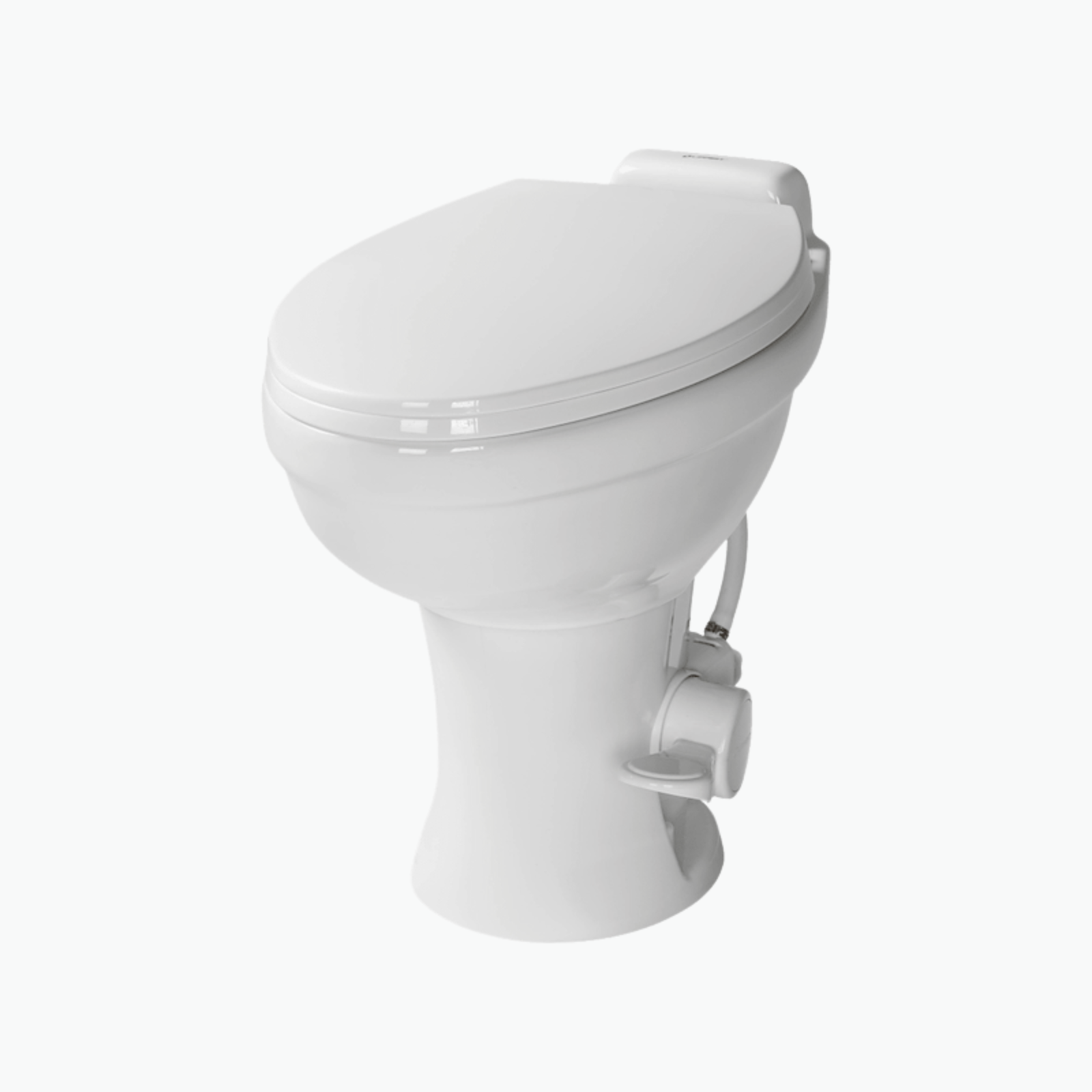
Occasional clogs are normal and usually a habit fix. But if you’re dealing with a toilet that leaks at the base, has a valve that won’t seal, or a pedal mechanism that’s worn out and no longer opens fully, repair parts exist for most models, but a full replacement is often the more practical fix — especially on an older unit. Chief Camper carries the Lippert Flow Max RV Toilet, which uses a foot-pedal-controlled full-bowl flush and a residential-style elongated seat, in the Sewer & Sanitation category alongside waste valves and tank treatments if you’re troubleshooting the rest of the system at the same time.
Waste Valve Problems That Mimic a Toilet Clog
Sometimes what looks like a toilet problem is actually downstream. A black tank valve that won’t fully open or close, or one that’s started leaking, will cause slow draining, backups, and odor that can feel exactly like a clog at the toilet itself. If you’ve ruled out the toilet and the clog seems to be at or past the valve, it’s worth inspecting the valve assembly — Chief Camper stocks replacement LaSalle Bristol cable-actuated waste valves and Valterra Bladex waste valve bodies for exactly this kind of repair.
Preventing Future Clogs
- Use RV-safe toilet paper only, every time.
- Always add a generous splash of water with each flush — don’t ration it to save tank space.
- Keep the black tank valve closed except when fully dumping.
- Use a holding tank treatment regularly, such as Valterra Pure Power Blue Holding Tank Treatment, to help break down solids between dumps.
- Rinse the tank with a wand or built-in flush system every time you empty it.
FAQs
Can I use regular toilet paper in an RV if I dump often?
It’s still risky. Even with frequent dumping, regular toilet paper doesn’t break down the way RV-safe paper does, and a single bad clog can mean an unpleasant repair. It’s a small cost to avoid a big headache.
Why does my toilet flush but nothing seems to leave the bowl?
This usually points to a water valve that isn’t opening fully, low water pressure to the toilet, or a partial blockage right at the valve seal. Check the water supply first, since it’s the easiest thing to rule out.
Is it normal for an RV toilet to smell even when it’s not clogged?
Some odor control is expected, but persistent smell usually means the black tank needs more water, a treatment, or a thorough rinse — not necessarily a repair.
A little water discipline and the right supplies solve the vast majority of RV toilet headaches. If you’ve worked through these steps and the problem is still there, it’s likely a worn valve or seal rather than a clog, and at that point replacing the affected part is usually faster and cheaper than continuing to fight it.
For more on keeping your RV’s water and waste systems in good shape before storage season, see our guide on how to winterize your RV water system.