Campground power isn’t always as clean as it should be. Loose pedestal wiring, overloaded park transformers, lightning strikes nearby, and simple miswiring at an older site can all send damaging voltage spikes — or dangerously low voltage — straight into your RV’s electrical system. A surge protector sits between the pedestal and your rig and catches those problems before they reach your converter, appliances, and electronics. The question most new owners run into is simple: do you need a 30-amp or a 50-amp unit?
It Comes Down to Your RV’s Shore Power Cord
The answer isn’t about how big your RV is or how much power you’d like to have — it’s about which electrical service your RV is actually wired for. Look at the plug on the end of your shore power cord:
- Three prongs (one flat, one angled, one round ground) means your RV has a 30-amp electrical system.
- Four prongs means your RV has a 50-amp electrical system.
Smaller travel trailers and truck campers are usually 30-amp. Larger fifth wheels and motorhomes, especially ones with multiple air conditioners, are more often 50-amp. You need a surge protector that matches this rating — not one that matches your campsite, and not one you pick based on your RV’s overall size.
Why the Amp Rating Actually Matters
The difference isn’t just the plug shape. A 30-amp connection is a single 120-volt leg, which works out to roughly 3,600 watts of total capacity. A 50-amp connection uses two separate 120-volt legs, giving you roughly 12,000 watts — more than three times the power. That’s why larger RVs with two air conditioners, residential refrigerators, and other high-draw appliances need 50-amp service: a 30-amp connection simply can’t deliver enough power to run everything at once without tripping a breaker.
A surge protector rated for the wrong service either won’t fit your cord at all, or in the case of using an adapter to force the fit, won’t actually be monitoring the correct legs of power — leaving part of your electrical system unprotected even though a protector is technically plugged in.
What About Dog Bone Adapters?
Adapters that let a 50-amp RV plug into a 30-amp pedestal (or vice versa) are common and useful for camping at older or smaller campgrounds. But they change the math: running a 50-amp RV through a 30-amp adapter limits your entire rig to 30-amp capacity, meaning you’ll need to manage your power draw carefully (running one air conditioner instead of two, for example). For surge protection, the safest approach is still to own a surge protector matched to your RV’s native service, and use the adapter between the protector and the pedestal — not to substitute a mismatched protector for the correct one.
Portable vs. Hardwired Surge Protectors
Surge protectors come in two basic formats:
Portable (Plug-In) Units
These plug into the pedestal, and your RV’s shore power cord plugs into them. They’re easy to move between your RV and other uses, simple to check at a glance, and don’t require any installation. The tradeoff is they sit outside, exposed to weather, and can be a target for theft at unattended sites if not secured.
Hardwired Units
These mount inside the RV’s electrical compartment and protect the system continuously without needing to be carried, plugged in, or watched at each site. They’re a “set it and forget it” option but cost more up front and require the RV’s power to be off during installation.
Basic vs. EMS (Electrical Management System) Protection
Not all surge protectors do the same job. A basic surge protector guards against voltage spikes — the kind caused by lightning strikes or park equipment switching on and off. An EMS unit goes further, continuously monitoring the incoming power for problems like low voltage, high voltage, open ground, reverse polarity, and miswired pedestals, and it will cut power to your RV automatically if it detects a dangerous condition rather than just absorbing a single spike. If you camp at a wide mix of campgrounds, including older or less-maintained parks, the extra monitoring an EMS unit provides is worth the added cost.
Chief Camper Surge Protector Options
Chief Camper carries surge protection for both 30-amp and 50-amp systems in the Power & Electrical category:
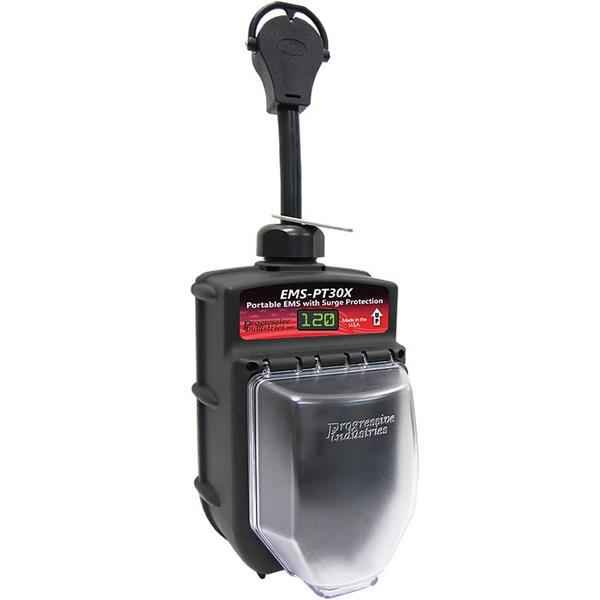
- The Progressive Industries EMS Portable RV Surge Protector (available in 30A and 50A) offers full electrical management system monitoring in a portable unit.
- The Progressive Industries SSP RV Surge Protector with Weather Shield (30A/50A) adds a weather shield for units left outside for extended stays.
- The Arcon RV Surge Protector is available in both 30-amp and 50-amp versions for straightforward surge protection.
- The Southwire Surge Protector is a 30-amp option that sits between the pedestal and your RV to guard the converter and appliances from spikes and voltage transients.
FAQs
Can I just buy the 50-amp unit in case I upgrade RVs later?
Only if you also have the correct adapter and understand you’re limiting protection to whatever service you’re actually plugged into. It’s simpler and safer to buy for the RV you have now and replace it if you move to a different amperage down the road.
Do I need a surge protector if my RV already has a built-in converter?
Yes. A converter changes AC power to DC for your RV’s 12-volt systems, but it doesn’t protect against voltage spikes, miswired pedestals, or the other problems a surge protector or EMS unit is designed to catch.
Is a hardwired or portable unit better for boondocking?
If you rarely plug into shore power, portable protection you can also use when you do connect at a campground or a friend’s house offers more flexibility than a hardwired unit that only works with your RV.
Matching your surge protector to your RV’s actual shore power service is the one detail that matters most — everything else, like portable versus hardwired or basic versus EMS, comes down to how and where you camp.
If you’re also looking at ways to manage power away from hookups, see our guide on keeping a portable power station charged on long road trips.